Power Binoculars 4×30
EastcolightIn stock

Power Binoculars 4×30

Lightweight, compact 4x30 binoculars with a wide field of view, ideal for nature walks and outdoor observation activities.

Age
⁦8+⁩ years
Grade levels
Grades 4–5Grades 6–8Grades 9–12
Request price

Pricing depends on quantity and configuration. Add to your quote list and we'll reply with an offer.

Order via WhatsApp

Product overview

These Eastcolight 4 x 30 binoculars (model 23181) are a lightweight, easy-to-carry optical tool for young explorers. They combine 4x magnification with 30mm objective lenses and high-quality optics, giving a wide field of view of 122m at 1000m that makes it easier for children to find and follow what they are looking at.

The low magnification and wide view suit beginners who are learning to use binoculars, while the compact size makes them convenient to pack for field trips, school gardens or playground observation.

In science and outdoor lessons, students can use them to watch birds and wildlife, observe weather and landscape features, and practice recording what they see in nature journals.

Key features

  • 4x magnification with 30mm objective lenses
  • Wide field of view: 122m at 1000m
  • High-quality optical lenses
  • Lightweight and easy to carry
  • Suited to nature walks and field trips
View on the official website

Related products

  • Grades 4–5Grades 6–8Grades 9–12

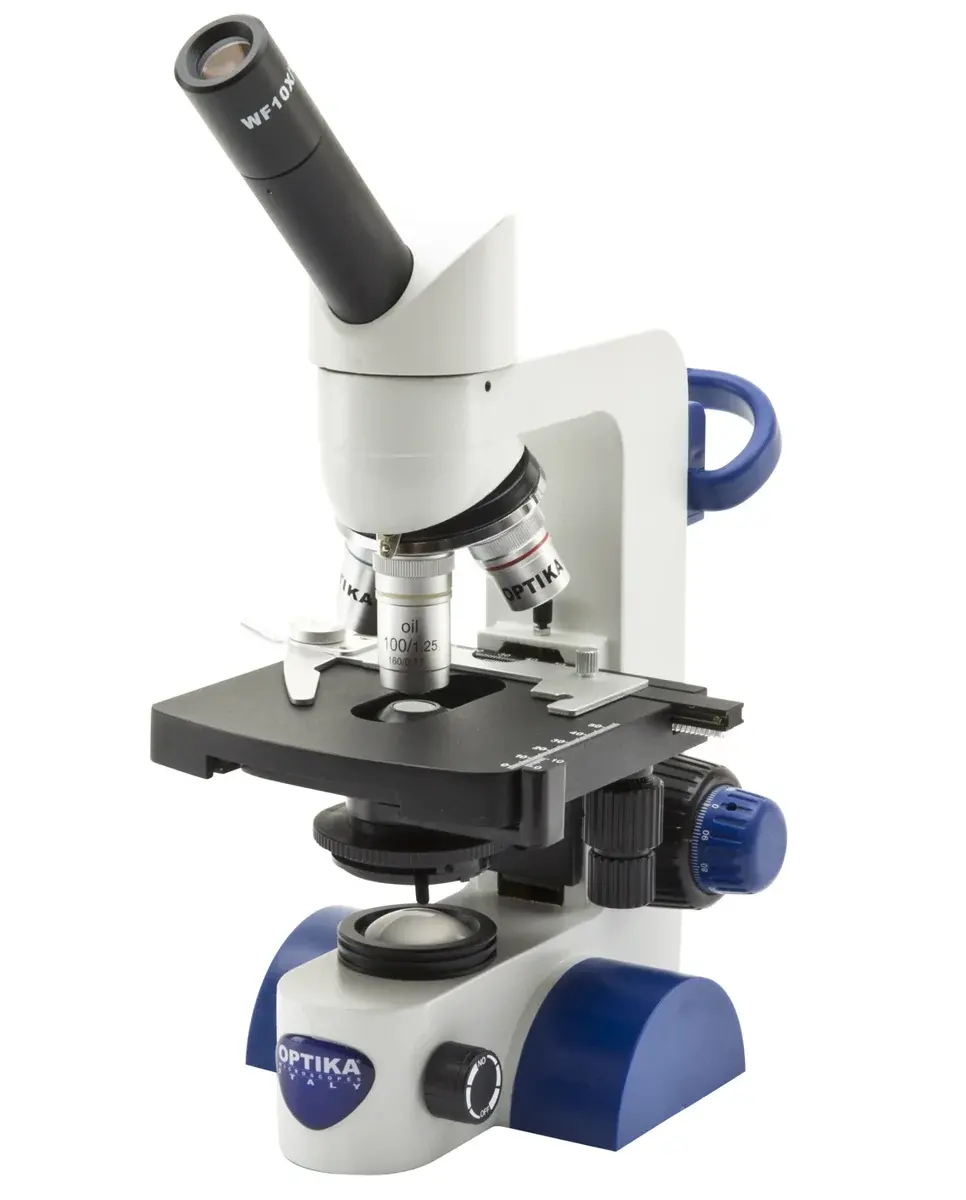
    Microscope B-65 Monocular Brightfield

    The OPTIKA B-65 is an educational biological microscope for brightfield observation. It has a monocular head inclined at 45° that rotates 360°, a WF10x/18 mm eyepiece secured by a screw, and four achromatic objectives (4x, 10x, 40x and 100x oil) with anti-fungus treatment, giving magnifications from 40x to 1000x. The StagErase™ mechanical stage measures 125 x 125 mm with a 62 x 24 mm X-Y range and a vernier scale, and scratches on its surface can be erased. Focusing is coaxial coarse and fine with a limit stop to prevent contact with slides, and an Abbe N.A. 1.25 condenser with iris diaphragm is pre-centered and focusable. Illumination is a 1 W LED with brightness control, powered by rechargeable batteries or a multi-plug external power supply, so it can be used without a fixed power outlet in school labs.

  • Grades 1–3Grades 4–5Grades 6–8

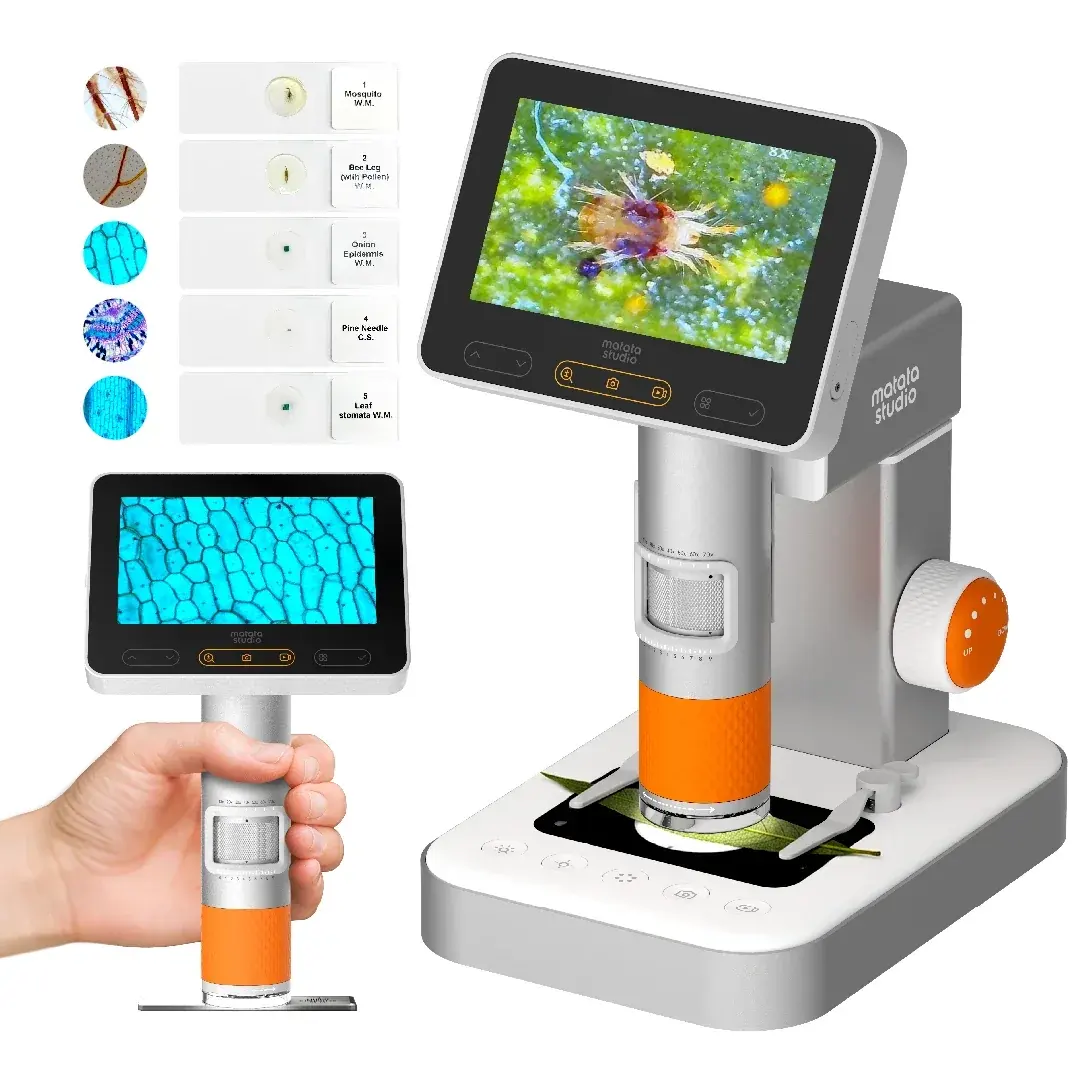
    MX2-AS Digital Microscope 100x–1600x (Wi-Fi, 4" touchscreen)

    The MatataStudio Digital Microscope MX2-AS pairs optical magnification with a digital camera so students can study the microscopic world on a screen instead of through an eyepiece. Its 4.3-inch capacitive display folds up to 135 degrees, and the microscope can be lifted out of its stand for handheld use indoors or outdoors. Learners can zoom continuously (about 9X to 72X on screen), switch between incident and transmitted lighting for solid objects or slides, and apply an on-screen color tint to bring out detail. Images and video are saved to 8GB of built-in storage, and Wi-Fi or a USB-C cable sends the live view to phones, tablets or computers, so a whole class can watch the same sample. The 2MP camera supports recording and measurement. The kit includes the microscope, MX stand, five prepared slides, two observation chambers, a USB-C cable, an exploration manual, two user guides and a storage bag, making it suitable for biology, geology and general science lessons.

  • Grades 1–3Grades 4–5Grades 6–8

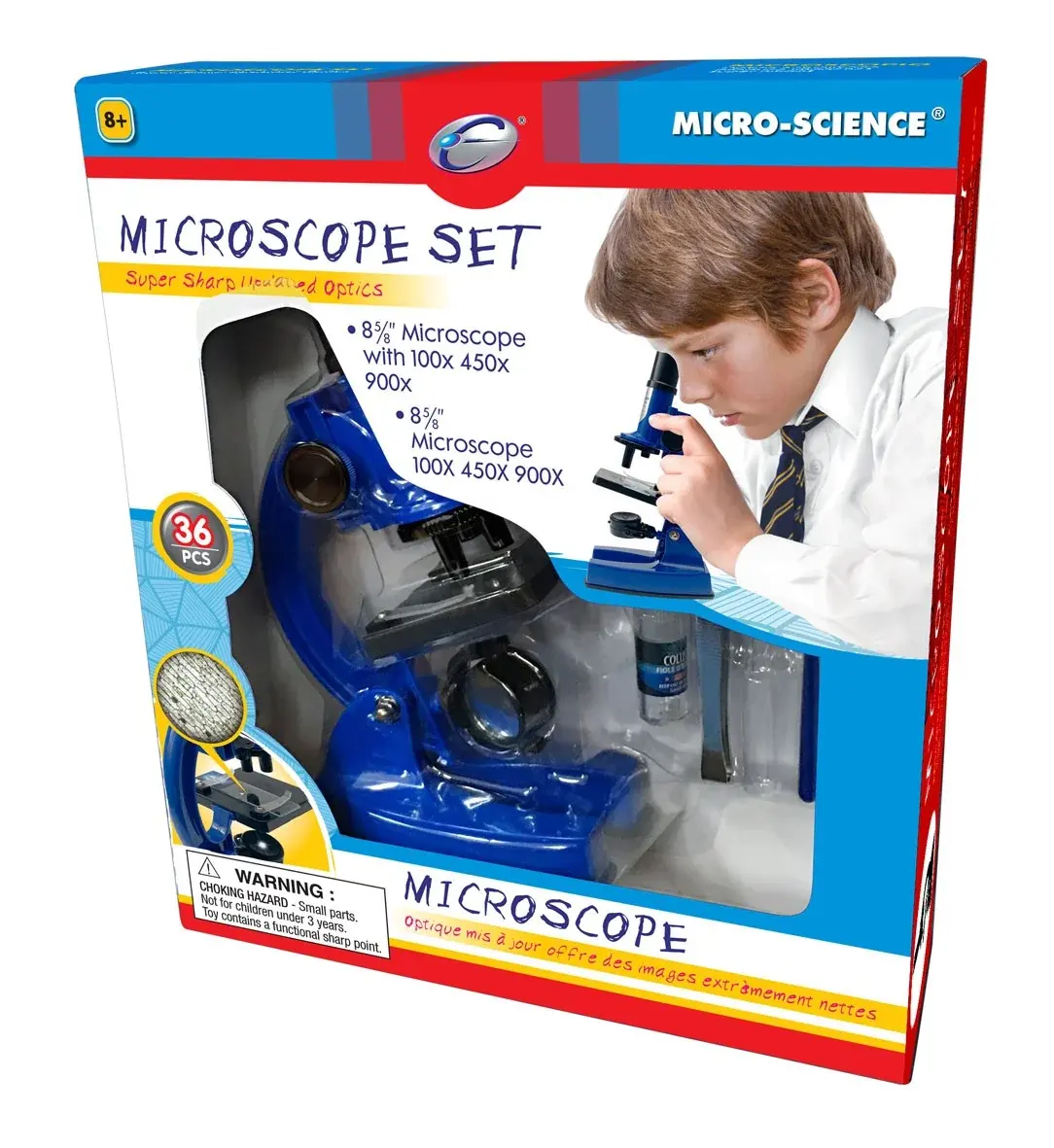
    Microscope Set 100/450/900X – 36 pcs

    This Eastcolight microscope set (models 21361/21362/21363, available in blue, black or red) gives young scientists a complete starter kit for exploring cells, fibres, insects and other small specimens. The roughly 8.6-inch microscope offers three magnification levels, 100x, 450x and 900x, so students can move from an overview of a sample to finer detail. Alongside the microscope, the set includes a magnifier, tweezers, a dissecting needle, 12 blank slides, 12 blank labels, one prepared slide, five cover slips and two collecting vials, plus an instruction manual. Two LR41 button batteries are included to power the microscope. In the classroom, students can collect samples in the vials, mount them on blank slides with cover slips, label their work and compare observations at each magnification, building practical skills in preparing and examining specimens.